
How Much Electricity Does a Tumble Dryer Use? Complete Guide + 5 Models to Know
-
18 August, 2026
Table of Contents
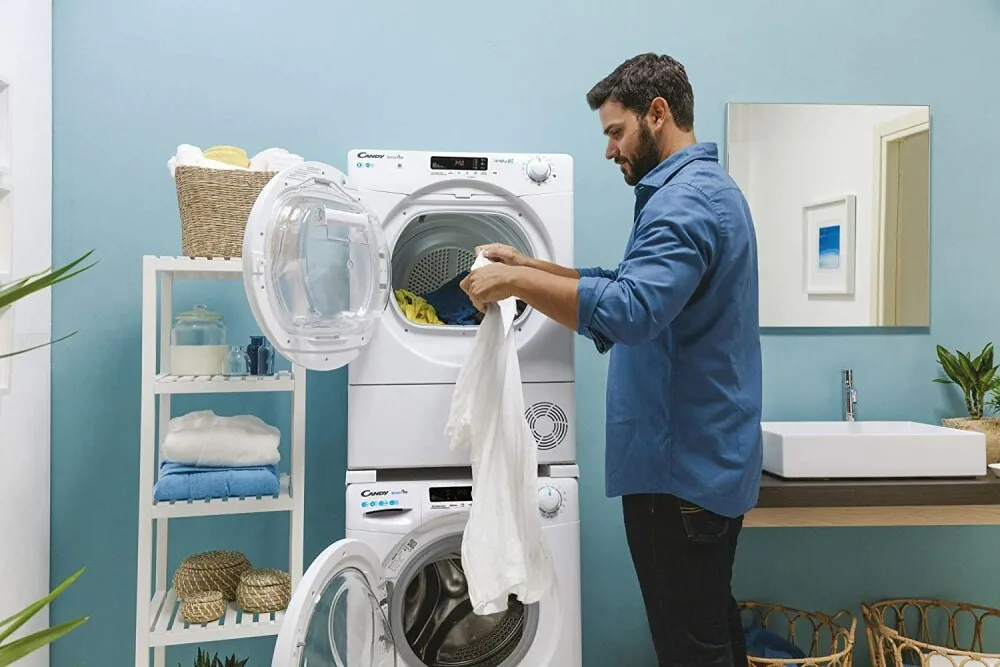
Buying a tumble dryer means finally making peace with the drying rack, with laundry that takes forever to dry in winter and with all that humidity we would rather keep out of the house. But one question remains — actually, two. How much electricity does a tumble dryer use, and how much does it really consume?
The short answer is: much less than older models used to consume, especially if we choose a modern heat pump tumble dryer and learn how to read the energy label correctly. The more useful answer, however, requires us to consider purchase price, capacity, number of cycles, technology and usage habits.
So, let’s see how to estimate the real cost of a tumble dryer, which features have the greatest impact on your energy bill and when choosing a washer dryer may be the more convenient option.

How much does a tumble dryer cost?
The price of a tumble dryer can vary considerably, and the brand is only one of the factors involved. Drum capacity, energy class, heat pump technology, sensors, automatic programmes, connectivity and self-cleaning systems can all have a significant impact on the final cost.
Looking at the current range from major brands, you can find more affordable models roughly in the €350-500 range, plenty of mid-range options between around €500 and €800, and more advanced or high-capacity tumble dryers that can reach and exceed €1,000-1,500. Brands such as Beko, Candy, Whirlpool, Bosch, Samsung and Electrolux currently cover very different price ranges and capacities. Of course, promotions and availability may change these figures over time.

Take a look for yourself. Here is a list of tumble dryers from some of the best brands, arranged by increasing price:
- Beko tumble dryers
- Samsung tumble dryers
- Candy tumble dryers
- AEG tumble dryers
- Bosch tumble dryers
- Electrolux tumble dryers
Remember, however, that spending less when you buy does not necessarily mean spending less in the long run. An inexpensive model that is poorly suited to your needs may require more cycles, while an oversized tumble dryer could mean paying for capacity you will rarely use. For this reason, the real goal should not be to find the cheapest tumble dryer, but the one that offers the best balance between price, energy consumption and actual use.

How much electricity does a tumble dryer use? Let’s learn how to read the label
There is an important change to be aware of. Since 1 July 2025, tumble dryers have used the new European energy label with an A-to-G scale, replacing the previous A+++ to D classification. The label also shows the weighted average energy consumption in kWh per 100 drying cycles, making it easier to compare different models.
This means you may still come across older online product sheets mentioning A+++, A++ or annual energy consumption. Be careful not to directly compare an old A+++ rating with a new C or D rating: the scales and assessment criteria have changed.
Let’s look at a simple example. If the label shows 120 kWh per 100 cycles, the theoretical average consumption is around 1.2 kWh per Eco cycle. To estimate the cost, simply multiply the energy consumption by the electricity rate stated in your contract.
Assuming, purely to make the calculation easier, an electricity cost of €0.30/kWh, 100 kWh would correspond to around €30, 120 kWh to €36, 160 kWh to €48 and 200 kWh to €60 every 100 cycles.

There is therefore no universal answer to the question “how much does it cost to use a tumble dryer each month?”. A household that runs two cycles a week will see a very different impact compared with someone who uses the appliance almost every day.
In addition, the figures shown on the label are calculated using the Eco programme under standardised conditions: quick programmes, different drying levels, the amount of laundry and the type of fabrics can all affect actual energy consumption.
Heat pump or condenser dryer: which uses less energy?
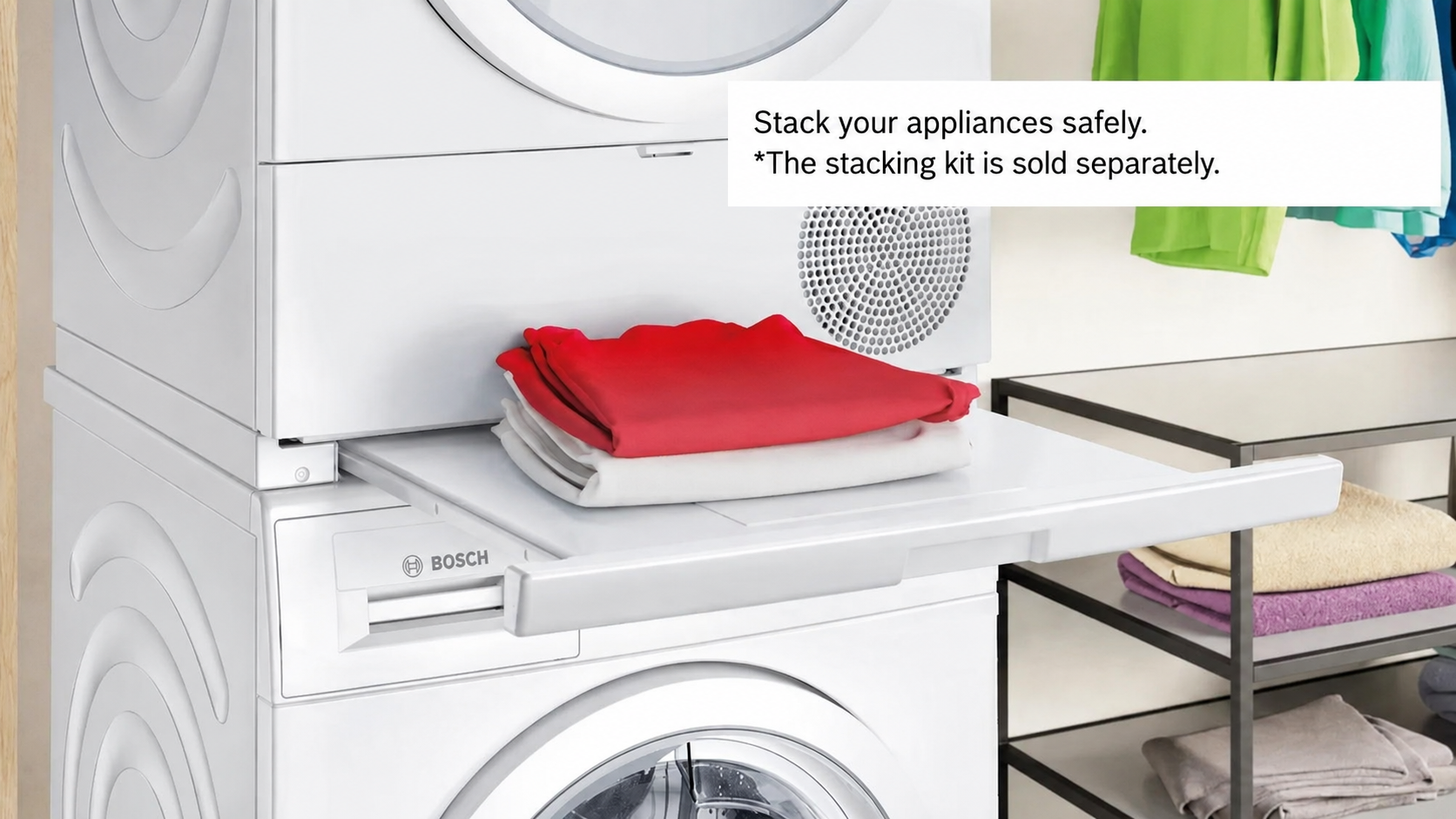
If you are buying a new tumble dryer today, you will mainly come across heat pump models. This is no coincidence: since July 2025, new appliances placed on the European Union market have had to comply with efficiency requirements that have made this technology the benchmark for the sector.
The heat pump recovers and reuses hot air during the cycle instead of continuously generating new heat through a simple heating element. The main advantage is significantly lower energy consumption. According to European Commission data, as early as 2020 a heat pump tumble dryer consumed an average of around 1 kWh per cycle, compared with approximately 2.7 kWh for the vented or condenser electric tumble dryers with heating elements considered in the analysis.

There is also a second advantage: because it generally operates at more moderate temperatures, a heat pump can be gentler on fabrics.
The downside? The purchase price can be higher and the most efficient programmes may take longer. In other words, an Eco cycle is not necessarily the fastest: its goal is to use energy as efficiently as possible.
For those who use their tumble dryer frequently, however, good energy efficiency tends to have a greater impact on the appliance’s overall cost over time.

How many kg should a tumble dryer hold?
Is bigger always better? Not necessarily.
In our catalogue, you can easily find tumble dryers with 7, 8, 9 and 10 kg capacities, as well as high-capacity models holding 16 or even 18 kg. To give you an idea, 7 kg is an interesting option for smaller households, while capacities of 10 kg and above are better suited to large families or anyone who regularly handles large amounts of laundry.
For an average household, 8-9 kg often represents the most versatile compromise. Larger capacities become particularly useful when you frequently dry bed linen, towels, duvets or large loads.
Be careful, however, with the “I’ll buy a huge one so I’m covered” approach. Underloading is not ideal from an energy-efficiency point of view either: the European Commission recommends staying reasonably close to the suggested rated load, avoiding both overloading and systematically running the appliance with only a few garments inside.
Capacity should therefore be chosen according to the amount of laundry you actually produce, not because you are worried that one day you might suddenly have three duvets to dry at the same time!

How to reduce tumble dryer energy consumption
Even the best energy class can be undermined by bad habits. Fortunately, reducing energy consumption does not require much effort.
One of the most effective tricks actually happens before you even switch on the tumble dryer: a good spin cycle in the washing machine mechanically removes more water from the fabrics, leaving less work for the drying stage. The European Commission itself points out that mechanically removing water is more energy-efficient than evaporating it in the tumble dryer.
It is also worth using moisture sensors, when available, instead of setting unnecessarily long drying times: continuing to heat clothes that are already dry means wasting energy and subjecting fabrics to stress that can easily be avoided.
Regularly cleaning the filters, following the recommended condenser maintenance instructions, avoiding excessively small loads and separating very heavy fabrics from lighter ones all help maintain high performance. Choosing the correct drying level matters too: if garments are going to be ironed, for example, systematically drying them to an “extra dry” level serves very little purpose.
In short, an efficient tumble dryer helps, but an efficient user helps even more.

Tumble dryer or washer dryer? Keep an eye on energy consumption
This is an important distinction, especially because both solutions can be found among the most popular models.
A tumble dryer performs the drying stage only. A washer dryer, on the other hand, combines a washing machine and tumble dryer in a single appliance. It is an extremely practical solution when space is limited or when you want to run a complete cycle without transferring the laundry from one appliance to another.
There is a compromise, however: drying capacity is normally lower than washing capacity. An 8 kg washer dryer, for example, may only be able to dry 5 or 6 kg. If the washing machine is fully loaded, you may therefore need to remove some of the laundry before starting the drying cycle.
The energy label is also different from that of a tumble dryer. Washer dryers separately show the efficiency of washing only and that of the complete washing + drying cycle, together with their respective consumption figures.
The choice is therefore very practical: if you have limited space and only use the drying function occasionally, a washer dryer can be an excellent compromise. If, on the other hand, you dry several loads a week and have room for two appliances, a dedicated heat pump tumble dryer offers greater capacity and allows you to choose the washing machine and dryer separately according to your needs.

5 best-selling models: features and energy consumption
Samsung tumble dryer DV16DG8600BVU3
The Samsung DV16DG8600BVU3 is a dedicated tumble dryer designed for anyone who considers 8 or 9 kg merely the starting point. It offers an impressive 16 kg capacity and uses Hybrid Heatpump technology. Under the new European energy label, it falls into energy class C, with a declared consumption of 155 kWh per 100 Eco cycles. The stated noise level is 64 dB.
Among its most interesting features are AI Control, Wi-Fi and SmartThings integration, as well as systems that adjust drying according to the laundry load. It is a particularly attractive solution for large families and anyone who frequently dries bulky laundry.

Beko washer dryer WDI85DAW_IT
Let’s switch categories: the Beko WDI85DAW_IT is a built-in washer dryer, combining two appliances in one. It offers a washing capacity of 8 kg and a drying capacity of 5 kg, with a spin speed of up to 1,400 rpm.
For the complete washing + drying cycle it belongs to class D, while washing alone reaches class A. Declared energy consumption for the complete cycle is 264 kWh per 100 cycles, with water consumption of 65 litres per full cycle.
The ProSmart Inverter motor is joined by features such as SteamCure, which uses steam, and IronFast, designed to reduce creases. Its strength is obvious: it combines washing and drying inside the cabinetry without taking up the space required by two separate appliances.

LG tumble dryer RH18U8AVCW
With an impressive 18 kg capacity, the LG RH18U8AVCW Series U8 is definitely playing in the big-load league. It is a DUAL Inverter heat pump tumble dryer with Direct Drive motor, AI Dry, Wi-Fi connectivity through LG ThinQ and a self-cleaning condenser.
Under the new European energy scale, it is rated class D and declares a consumption of 178 kWh per 100 cycles, with a noise level of 63 dB.
AI Dry recognises load characteristics such as fabric type and moisture level to optimise drying, while the 6 Motion system varies the movement of the drum. It is a particularly suitable option when capacity and the ability to manage large amounts of laundry matter more than keeping dimensions to a minimum.

Hotpoint Ariston washer dryer BI WDHG 861485 EU
The Hotpoint Ariston BI WDHG 861485 EU is a built-in washer dryer with a washing capacity of 8 kg and drying capacity of 6 kg. The complete cycle has an energy rating of D, while washing only is rated B.
The complete washing + drying cycle has a declared consumption of 307 kWh per 100 cycles, while using the appliance for washing only reduces the figure to 55 kWh/100 cycles. The complete cycle uses 65 litres of water.
Features include Steam Refresh to freshen garments with steam, an Inverter motor, Digital Motion and Stop&Add. Its 6 kg drying capacity is an interesting option for those looking for an integrated solution without being limited to very small loads.

Candy tumble dryer CRO4 H7A2TE-S Smart Pro
The Candy CRO4 H7A2TE-S Smart Pro is a 7 kg heat pump tumble dryer with a slim design and a depth of around 48 cm: a practical solution for anyone with limited space who does not want to give up smart features.
It belongs to energy class E and declares consumption of around 112 kWh per 100 cycles. It offers 14 programmes, Wi-Fi and Bluetooth connectivity through the hOn app, as well as dedicated programmes for wool garments.
It is particularly suitable for singles, couples and small households looking for a compact heat pump model with smart management.

FAQ: frequently asked questions about tumble dryer costs and energy consumption
How much energy does a tumble dryer use per cycle?
It depends on the model and programme. The easiest way to compare two modern tumble dryers is to check the energy consumption in kWh per 100 cycles on the label and divide it by 100. An appliance rated at 120 kWh/100 cycles, for example, has a standardised average consumption of around 1.2 kWh per Eco cycle.
How much does one tumble dryer cycle cost?
You need to multiply the kWh consumed by the electricity rate stated in your contract. If one cycle uses 1.2 kWh and we assume a rate of €0.30/kWh, the energy cost is around €0.36.
How much does a tumble dryer affect your energy bill?
It mainly depends on the number of cycles. A household using it once a week will have a very different expense from one running five or six drying cycles. For a reliable estimate, start with the kWh/100 cycles figure shown on the energy label and calculate it according to the number of cycles you actually run.
Which tumble dryer uses the least energy?
When capacity and usage conditions are comparable, it is best to compare the energy class and, above all, the numerical kWh/100 cycles figure shown on the label. Today, heat pump technology represents the standard for new tumble dryers placed on the European market.
Is today’s class C worse than the old A+++?
A direct comparison is not possible. Since July 2025, tumble dryer energy ratings have been rescaled from A+++–D to A–G, and the label criteria have changed. When comparing two products, it is therefore important to check that the figures refer to the same classification system.
Is an 8 kg or 9 kg tumble dryer better?
It depends on your washing machine and the amount of laundry you normally handle. For an average household, both capacities can work well; 9 kg offers greater flexibility for towels, bed linen and bulkier loads, while 8 kg may be perfectly sufficient for smaller households.
Is it worth buying a very large tumble dryer?
Only if you will actually use the capacity. Models with 16-18 kg capacities are excellent for large families, substantial amounts of laundry or bulky textiles, but they are not automatically the best choice for a couple drying only a few garments at a time.
Is a tumble dryer or washer dryer better?
A washer dryer saves space and allows you to manage washing and drying with a single appliance. A separate tumble dryer, on the other hand, is preferable when the drying function is used frequently, because it offers greater dedicated capacity and allows you to choose a heat pump machine specifically optimised for drying.

Useful Links and Contacts
There is no single best tumble dryer for everyone: there is the one that best suits the amount of laundry you handle, the space available and how often you expect to use it.
Before buying, make sure you check capacity, consumption in kWh/100 cycles, energy class, available programmes, dimensions and drying technology. And remember: saving a few euros today is not always a real saving if the model you choose consumes more energy or does not meet your needs.
Still have questions about capacity, energy consumption or the difference between a tumble dryer and a washer dryer? Contact us here: our experts are available to help you compare models and find the solution that best suits your home, your habits and your laundry.
Because saying goodbye to the drying rack is great. But doing it without nasty surprises on your energy bill is definitely next-level.
Don’t forget to take a look at our other articles too. We’re sure you’ll find plenty of useful advice for your home and keep up to date with the latest news and trends:
- How to Clean the Washing Machine: 7 Steps to Get Rid of Dirt and Bad Odours
- How to Make the Bed Perfectly: The Complete Guide to a Hotel-Style Look and 5 Top Beds
- How to Clean the Oven in 5 Minutes: 7 Tips for Getting It Sparkling Clean Without Stress
And today, too, we’ve earned ourselves some positive karma points.
See you next time!
Your Vieffetrade Team