
How to Make the Bed Perfectly: The Complete Guide to a Hotel-Style Look and 5 Top Beds
-
30 June, 2026
Table of Contents
Making the bed—for those who actually do it—is one of those tasks we perform almost automatically: we pull up the sheets, straighten the duvet, put the pillows back in place and consider the mission accomplished. After all, what could there possibly be to explain?
And yet, all it takes is stepping into a hotel room to realise that not all made beds are created equal. Perfectly smooth sheets, neatly arranged covers, plump pillows and harmonious colours can transform even the simplest room into a welcoming, well-designed space.
The good news is that you do not need to take a hotel housekeeping course or spend half an hour every morning creating millimetre-perfect corners. To learn how to make the bed perfectly, all you need is a clear method, well-chosen textiles and a few simple tricks.
Here are five tips for creating an elegant, tidy and inviting bed.

1. How to make the bed properly: first of all, do not make it straight away
It may sound counterintuitive, but the first trick to making the bed properly is to wait a few minutes before tidying it. During the night, the mattress, pillows and bed linen retain some of the heat and moisture produced by the body. Covering everything immediately with a duvet and bedspread is therefore not the best solution.
As soon as you wake up, it is better to open the window and pull back the sheets and covers. The bed can air while you get ready or have breakfast. There is no need to leave the room open for hours. Even a brief change of air helps freshen the bed linen and disperse some of the moisture that has built up while you slept.
This is also the right time to gently shake the pillows and duvet, restoring volume to the filling and distributing it evenly.

How to make the bed according to its design
The type of bed and its position in the room can also change the best way to proceed.
- A double bed positioned in the centre of the wall is the easiest to make, because both sides are within easy reach. When the bed is placed against a wall, however, it is best to start from the least accessible side. This way, you will not have to climb onto the mattress at the end and risk creasing everything you have just arranged.
- With a storage bed, you need to pay attention to the length of the textiles. Very long bedspreads and heavy blankets can obstruct the opening of the base or become trapped in the mechanism.
- Low beds generally look more balanced with bed linen that has a shorter drop, while taller frames can accommodate slightly longer quilts and bedspreads.
- Finally, if the bed has an upholstered, detailed or particularly decorative headboard, it would be a shame to hide it completely behind a mountain of pillows. The arrangement should enhance it, not make it disappear.

2. How to make bed corners and keep the sheets smooth and taut
The secret to a tidy bed is often hidden in the part you see the least. Elegant duvets and decorative cushions may catch the eye, but if there are creased sheets or corners that keep coming loose underneath, that feeling of comfort will not last long.
The first element to check is the mattress protector. It should fit closely to the surface without creating creases, both for aesthetic reasons and to make the bed more comfortable.
Next comes the fitted sheet, which must suit not only the width and length of the bed, but also the depth of the mattress. If the corners keep lifting during the night, the problem may not be how the bed is made: the sheet is often simply too small or not deep enough.
To fit it properly, it is best to start at the head of the bed, securing the two top corners first and then moving on to the bottom ones. The fabric can be tightened gradually around the edges without pulling too hard—the seams will thank you.

How to make the bed with a flat sheet
If you use a flat sheet, lay it over the mattress while leaving a longer section towards the head of the bed. You will need it to create the final fold over the blanket or duvet.
Before tucking it in, it is important to check that the fabric is centred and hangs to the same height on both sides. It is a simple check, but it prevents you from discovering at the end that there are twelve extra inches of sheet on one side and almost none on the other.
The sheet can be tucked in only at the foot of the bed or along the sides as well. There is no single rule for everyone: some people enjoy feeling cocooned in a neatly tucked bed, while others prefer greater freedom of movement.
Making the bed perfectly does not mean turning it into an airtight package. You can therefore leave a little looseness around the feet, combining neatness with comfort.
How to make hotel-style bed corners
Hospital corners are one of the details that contribute most to the classic hotel look. The name may not sound especially inviting, but the result is clean, elegant and very practical.
After tucking the bottom edge of the sheet under the mattress, lift the fabric at the side to create an angled flap. Tuck the section left hanging below under the mattress, then fold the raised flap back down and secure it along the side.
This creates a neat, precise corner without bulky folds of fabric. The same method can be used with a thin blanket or lightweight bedspread, although it becomes less practical with quilts and very thick textiles.
There is no need to reach for a ruler: the goal is a tidy result, not passing a military inspection.
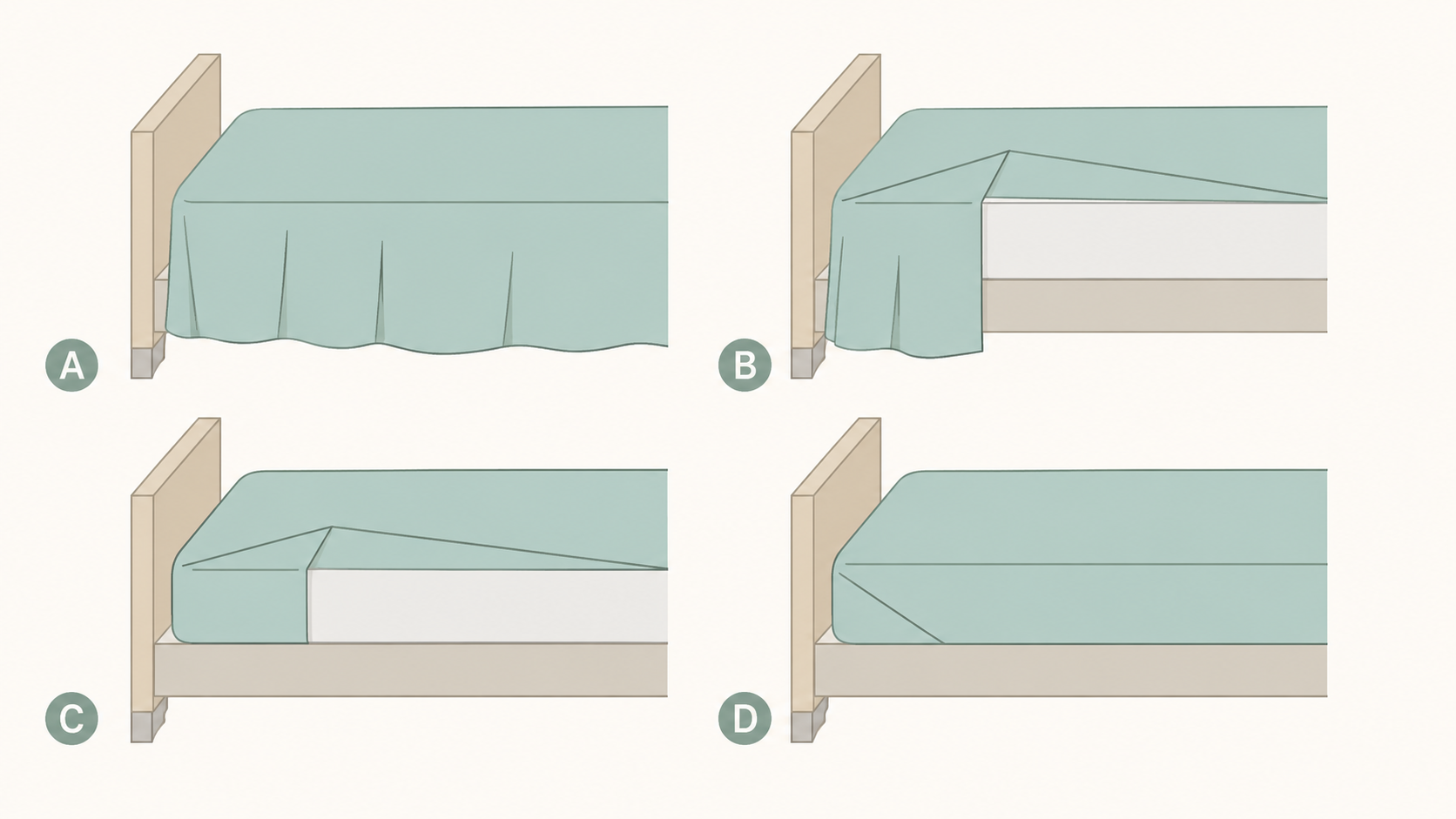
There are several ways to arrange the corners of a bed. Here are a few alternatives:
- Simplified diagonal corner. Lift the side flap to create a diagonal line, tuck in only the lower section and lower the flap without creating all the rigid folds of the traditional method. The result is neat but softer.
- Continuous tuck. Gradually tuck the sheet under the mattress around the entire perimeter, guiding the fabric with your hands and distributing the folds. This method is particularly suitable for low beds or lightweight mattresses.
- Fitted sheet with elasticated corners. No folds are required: the shaped corners wrap directly around the mattress. It is the most practical solution for the bottom sheet, while the top sheet still requires you to choose a tucking method.

How to arrange the covers on the bed
The traditional order of layers is:
- mattress protector;
- fitted sheet;
- optional flat sheet;
- blanket, quilt or duvet;
- bedspread, throw or decorative bed runner.
This does not mean that you have to use them all at the same time. The number of layers depends on the season, the temperature of the room and your own habits.
With the so-called Nordic method, for example, you can skip the flat sheet and sleep directly under the duvet, protected by a washable duvet cover. Those who prefer a more traditional arrangement can instead combine a sheet, blanket and bedspread.
The best choice is always the one that makes the bed comfortable and easy to manage. Adding textiles simply because they “look good” may mean ending up with a pile of covers to move onto a chair every evening.
3. How to make the bed with a duvet and choose covers and materials
Layering textiles is one of the features that makes hotel beds so inviting. The secret, however, is not to use everything you can find in the wardrobe.
A duvet, quilt, blanket, bedspread and throw do not necessarily have to share the same mattress. A few carefully selected and neatly arranged layers look more elegant than an overloaded composition.

How to make the bed with a duvet
Before spreading out the duvet, it is helpful to hold it by the top corners and give it a gentle shake. This allows the filling to redistribute itself inside the duvet cover, preventing empty patches and irritating clumps.
Once placed on the bed, it should be centred and hang evenly on both sides. To check, simply look at the bottom edge or make sure that the side seams sit at the same height.
If you are using a flat sheet, the upper part of the duvet can be folded down together with it. The fold creates a neat separation between the layers and immediately gives the bed a more refined appearance.
When the duvet is used without a flat sheet, it can instead reach all the way to the headboard or be folded down slightly to add more volume to the arrangement.
How to make the bed with a quilt or bedspread
The quilt and bedspread should be proportioned not only to the mattress, but also to the height of the entire bed frame.
A model that is too short leaves the sides exposed; one that is excessively long may trail on the floor, collect dust and make the bed look less tidy.
A padded quilt can serve both a thermal and decorative purpose. A lightweight bedspread, on the other hand, is perfect for spring and autumn or as a final layer over sheets and a blanket.
In both cases, the fabric should be centred before being tucked in or allowed to fall over the sides. Correcting its position at the beginning takes only a few seconds; trying to straighten everything after arranging the pillows is much less fun.

How to use throws and bed runners for a hotel-style look
Throws and fabric bed runners are small style allies. Placed at the foot of the bed, they add colour, volume and a different texture without forcing you to replace all the bed linen.
For a classic, orderly result, the throw can be folded into a neat band and placed horizontally across the lower section. In a modern bedroom, it can instead be draped more casually over one corner.
Its width should be proportionate to the size of the bed. A strip that is too narrow looks almost as though it was forgotten there by accident; an enormous blanket risks hiding everything else. As a general rule, it is enough to cover the final quarter or third of the mattress.
Which materials to choose for an elegant bed
Materials determine not only how the bed feels against the skin, but also the appearance of the entire room.
- Cotton is the timeless classic: versatile, durable and breathable. Cotton percale has a cool, matte surface, perfect for a simple and orderly bed. Cotton sateen, on the other hand, is smoother and more lustrous, giving the room a more sophisticated elegance.
- Linen is ideal for those who love a natural, relaxed style. Its creases are part of the fabric’s charm and do not need to be eliminated at all costs. In fact, they help create the kind of apparently effortless elegance that has actually been very carefully considered.
- Flannel is a suitable choice for the colder months. Soft and warm, it makes the bed look more cosy and enveloping. To avoid an overly heavy effect, it can be paired with simple quilts and just a few accessories.
- Velvet adds depth and subtle reflections to the arrangement. It is best used in small doses, for example on cushions, bed runners or throws, especially in smaller bedrooms.
- Wool, wool blends and knitted fabrics are ideal for winter blankets. Their contrast with the smooth surface of the sheets makes the bed more interesting, even when all the elements belong to the same colour family.

4. How to create an elegant bed by combining colours and patterns
White is the signature colour of hotel rooms: it looks fresh, bright and instantly tidy. This does not mean, however, that you have to give up every other shade to achieve the same effect.
The simplest way to create a harmonious arrangement is to choose one main colour, one secondary shade and one small accent colour.
- The main colour covers the largest surface and may be white, ivory, beige, taupe or light grey.
- The secondary shade can appear on the duvet cover, quilt or bedspread and should echo an element already present in the room, such as the headboard, curtains, rug or a wall.
- The accent colour gives the arrangement personality. It can be introduced through a throw or one or two decorative cushions, using shades such as sage green, powder blue, terracotta, teal or mustard. The principle is simple: the accent colour should be noticeable, not take control of the entire room.
How to make the bed with a tonal colour scheme
A tonal palette is one of the safest ways to achieve an elegant result. It involves combining different shades of the same colour, creating depth without relying on overly strong contrasts.
You could, for example, pair ivory sheets with a beige duvet cover and a hazelnut-brown throw. In a grey bedroom, you might use a white base, a pearl-grey quilt and charcoal cushions.
To prevent the arrangement from looking flat, it helps to alternate different materials. Cotton, linen, velvet and wool reflect light differently and create movement even when their colours are almost identical.

How to coordinate the bed with the bedroom
Bed linen should not live a separate life from the rest of the interior. Colours and materials should echo at least one or two elements in the room, without necessarily matching them exactly.
- With a large or striking upholstered headboard, for example, simple, plain-coloured textiles are often enough.
- A bed with clean, essential lines can instead be enhanced with textured covers, bolder shades or decorative cushions.
- In modern bedrooms, solid colours, clear contrasts and geometric arrangements work particularly well.
- Classic interiors can accommodate quilts, decorative borders and richer fabrics.
- Nordic style favours pale shades, linen, cotton and knitted blankets.
- A rustic bedroom can be completed with warm colours, natural fibres and understated patterns.
- In minimalist spaces, on the other hand, it is better to limit the layers and let the shapes and materials speak for themselves.
How to combine patterns and colours without creating confusion
When the duvet cover features a floral, geometric or abstract pattern, most of the other elements should remain plain. Sheets, throws and cushions can pick up one of the colours in the design without introducing too many new ones.
On a monochrome base, you can instead add one or two patterned cushions or a blanket with a distinctive texture.
Mixing different patterns is not forbidden, but it requires care. When in doubt, it is better to choose one main pattern and accompany it with simpler elements.
The bed should catch the eye, not put it through an endurance test.

5. How to create a hotel-style bed with the right pillow arrangement
Pillows are the finishing touch: they add volume, colour and that sense of softness that makes a bed instantly inviting. Their number, however, should be proportionate to the size of the mattress and to the real life of the person using the room.
- On a double bed, the most practical arrangement includes two sleeping pillows and one or two decorative cushions.
- For a fuller look, you can use two large pillows against the headboard, two sleeping pillows in front and one or two smaller cushions.
Five or six pillows are generally enough to achieve a hotel-style result. Those who prefer a more minimal look can stop at three or four, avoiding the need to transfer half the arrangement onto an armchair every evening.

How to arrange pillows on the bed
The basic rule is very simple: larger pillows go at the back and smaller ones at the front.
They can be placed upright against the headboard for a tidier, more structured effect, or angled slightly to create a softer, more relaxed arrangement.
A rectangular cushion in the centre can complete the look and create a focal point. It should, however, be proportionate to the other elements: neither so small that it disappears nor so large that it occupies half the bed on its own.
Symmetry is ideal for classic bedrooms and interiors designed to reproduce the hotel aesthetic faithfully. In a contemporary room, you can instead choose a freer arrangement, with fewer elements and a slight asymmetry.
The covers should also work with the rest of the bed linen. On a plain duvet cover, you can introduce cushions in velvet, raw linen, bouclé or patterned fabric. If the base is already decorative, plain-coloured designs are the better choice.
How many pillows to put on a single bed
On a single bed, one or two sleeping pillows and one decorative cushion are generally enough. With a wide headboard, you can add another, provided that the mattress does not disappear beneath the entire arrangement.
Here too, practicality matters.

Mistakes to avoid when making the bed: a quick summary
- Using sheets in the wrong size;
- failing to centre the sheets on the bed;
- layering too many textiles without considering the season;
- combining too many different patterns and colours;
- choosing pillows that are out of proportion with the bed;
- completely hiding a decorative headboard;
- using so many accessories that you do not know where to put them in the evening;
- leaving the duvet bunched up inside the duvet cover;
- ignoring creases and bulky folds in the lower layers.
The bed should look polished, but it should also be comfortable and easy to use. Recreating an arrangement seen in a photograph without adapting it to your own bedroom may produce a very dramatic result—and a decidedly impractical one.
5 high-quality beds for a five-star hotel look
Samoa bed QUEEN
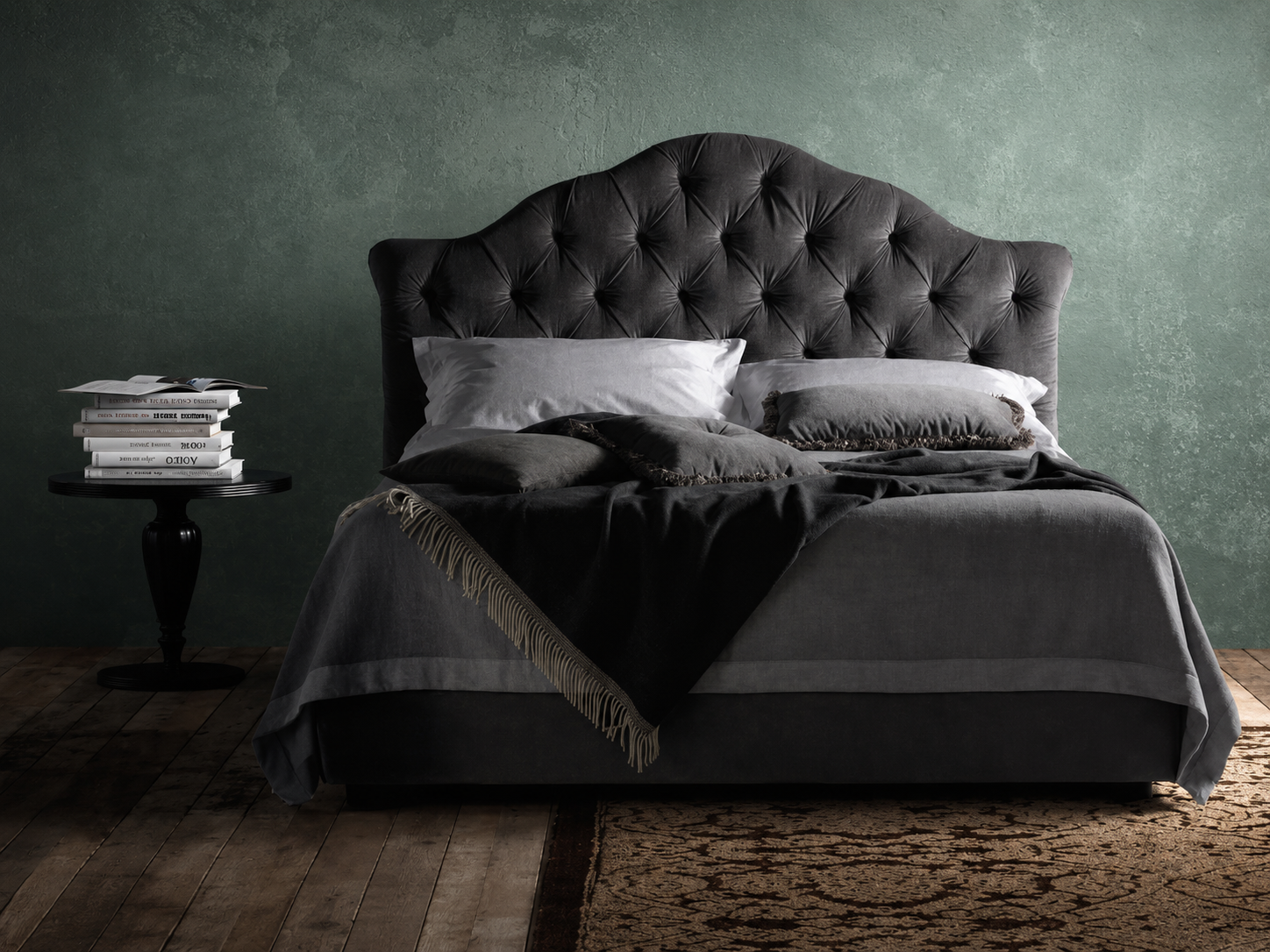
Queen by Samoa is an elegant, striking upholstered bed, instantly recognisable by its curved button-tufted headboard, which can be customised with covered buttons or Swarovski crystals. The partially removable cover is available in fabric or faux leather, while the bed frame can be completed with an elegant valance at no extra cost.
Available as a small double, double or king-size bed, it can be selected without a bed base, with the Bed orthopaedic base, the motorised Ergo base or with a storage compartment featuring the Pivot or Logical opening system. The upholstered frame, customisable feet and optional castors complete a model that combines style, comfort and practicality. Mattress not included.
Samoa bed FLUX
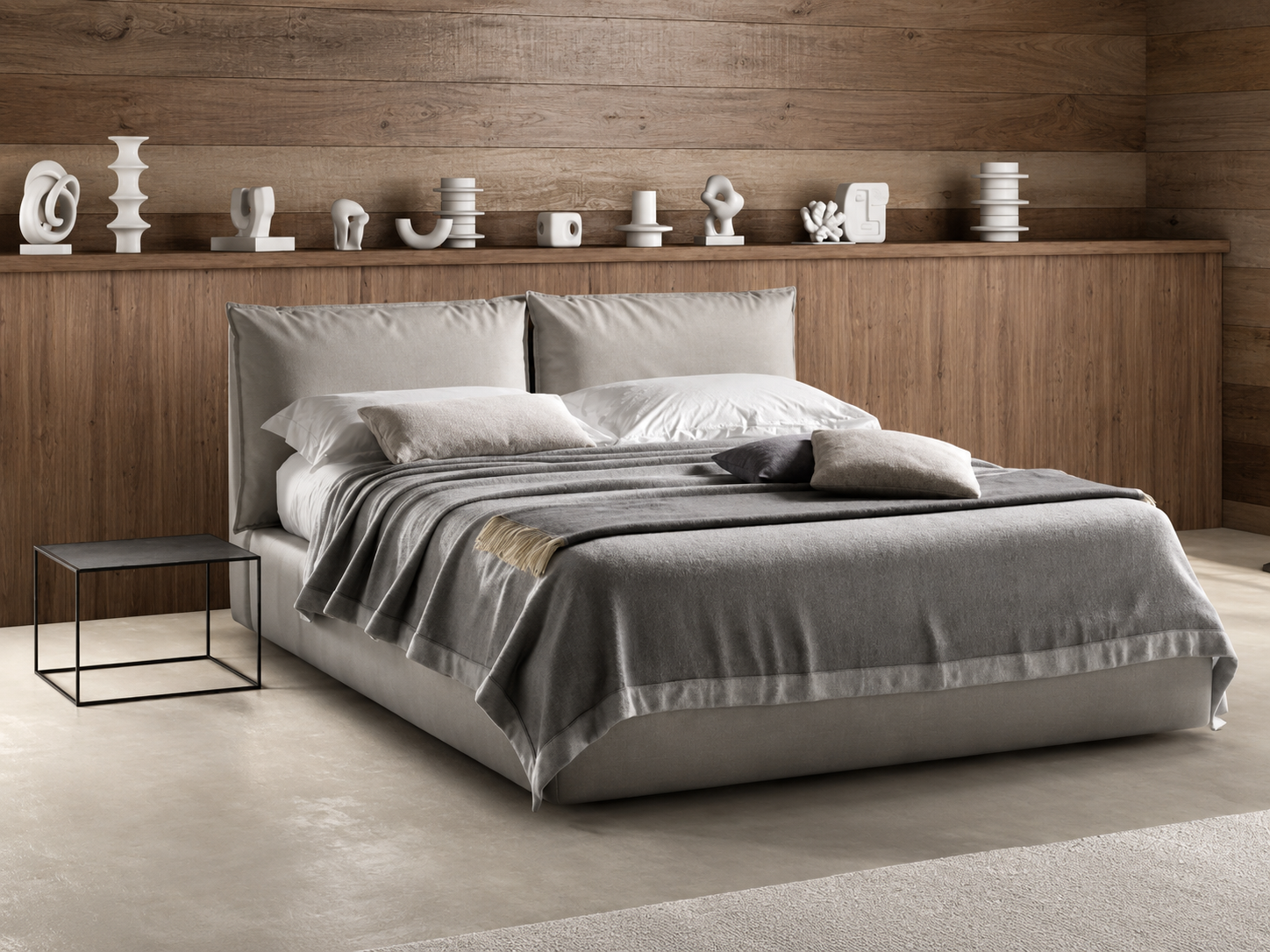
Flux Lift by Samoa combines modern character with intelligent comfort, thanks to its distinctive double-effect headboard with adjustable cushions, perfect for reading or watching TV without improvising towers of pillows. It can also be customised in a two-tone version, with a fully removable fabric cover or a partially removable faux-leather cover. On request, the headboard can incorporate practical adjustable lights.
Available from single to king size, it is offered without a storage compartment and with or without the Bed orthopaedic base. The slim bed frame and 18 cm-high feet make the structure look lighter and simplify cleaning underneath. The feet and finishes are customisable. Mattress not included.

Samoa bed QUIET
Quiet by Samoa transforms the headboard into a genuine relaxation corner: the large double-stitched cushions can be raised and adjusted, providing comfortable support for reading or watching TV without building pyramids of pillows. Available in 12 sizes, from single to king size, it features a fully removable fabric or faux-leather cover and customisable Cubic feet.
It can be selected without a bed base, with the Bed orthopaedic base or with a storage compartment featuring the Pivot opening system. The Rise and Logical dual-lift systems are also available on request, making it easier to make the bed. Mattress not included.
Felis bed KARL
Karl by Felis reinterprets button tufting with a younger, more original twist: its large-panel headboard is embellished with multicoloured buttons, which can also be customised in matching or contrasting shades or with Swarovski crystals. With a fully removable cover, it is available in fabric, microfibre, velvet or faux leather and in sizes ranging from single to super king.
It can be selected without a bed base, with the Armony base or with the Dynamic storage compartment, which opens at a 45-degree angle and includes dust brushes. Alternative bed bases, customisable feet and the practical Clean Up System are available on request; the latter lifts and moves the bed to make cleaning underneath decidedly less of a chore.

Felis bed GEORGE
George by Felis balances bold lines with a desire to relax: generous volumes, squared shapes and edge stitching give it a modern, tailored character. The headboard cushions can be tilted manually and, in the double-bed versions, adjusted separately, allowing each person to find the ideal position for reading, working or watching TV. The cover is fully removable and available in fabric, microfibre, velvet or faux leather, including versions with contrasting cushions.
Available from single to super king size, George can be selected without a bed base, with the Armony base or with the Dynamic storage compartment, which opens from the front at a 45-degree angle and is fitted with dust brushes and panels with handles. Alternative bed bases and the Clean Up System are available on request; the latter lifts and moves the bed to simplify cleaning underneath. Mattress not included.

FAQ: frequently asked questions about how to make the bed
1. How long should you air the bed before making it?
Around 10–20 minutes is enough, preferably with the window open and the sheets and covers pulled back.
2. How can you stop a fitted sheet from coming loose?
Choose a sheet that suits both the size and depth of the mattress, securing the top corners first and then the bottom ones.
3. How do you make hotel-style bed corners?
Tuck in the bottom edge of the sheet, lift the side flap diagonally, tuck the lower section under the mattress and fold the raised fabric back down.
4. In what order should sheets and covers be arranged?
The classic order is: mattress protector, fitted sheet, optional flat sheet, blanket or duvet, followed by a throw, bed runner or bedspread.
5. How do you arrange a duvet neatly?
Shake it to distribute the filling, centre it on the mattress and adjust it so that it hangs to the same height on both sides.
6. How many pillows do you need for a hotel-style look?
Four to six pillows are generally enough on a double bed, with the larger ones at the back and the decorative cushions in front.
7. How should you coordinate the colours of your bed linen?
Choose one main colour, one secondary shade and a single accent colour, coordinating them with the headboard, curtains, walls or rug.
Contact details and useful links
Learning how to make the bed perfectly means finding the right balance between order, comfort and style.
A hotel-style result does not depend on the number of blankets or pillows, but on harmonious proportions, the choice of materials and the care used to arrange each element. A few simple moves can change everything.
At this point, you know everything you need to give your bedroom a fresh new look!
And since another motto worth remembering is messy is fine, but dirty never, here are a few more useful tips to help you stay one step ahead of the devil:
- How to Clean a Sofa: the Complete Guide and 5 Easy-to-Clean Sofas
- How to Clean a Mattress: 6 Tips for Always Sleeping on a Fresh, Clean Surface
- How to Clean an Air Conditioner: 7 Practical Tips to Breathe Better and Spend Less
For everything else, we are here to help! Contact us here and we will answer all your questions.
See you next time!
Your Vieffetrade Team