
How Many kW Are Needed to Heat 100 sqm? The Correct Calculation and 8 Essential Tips
-
23 September, 2026
Table of Contents
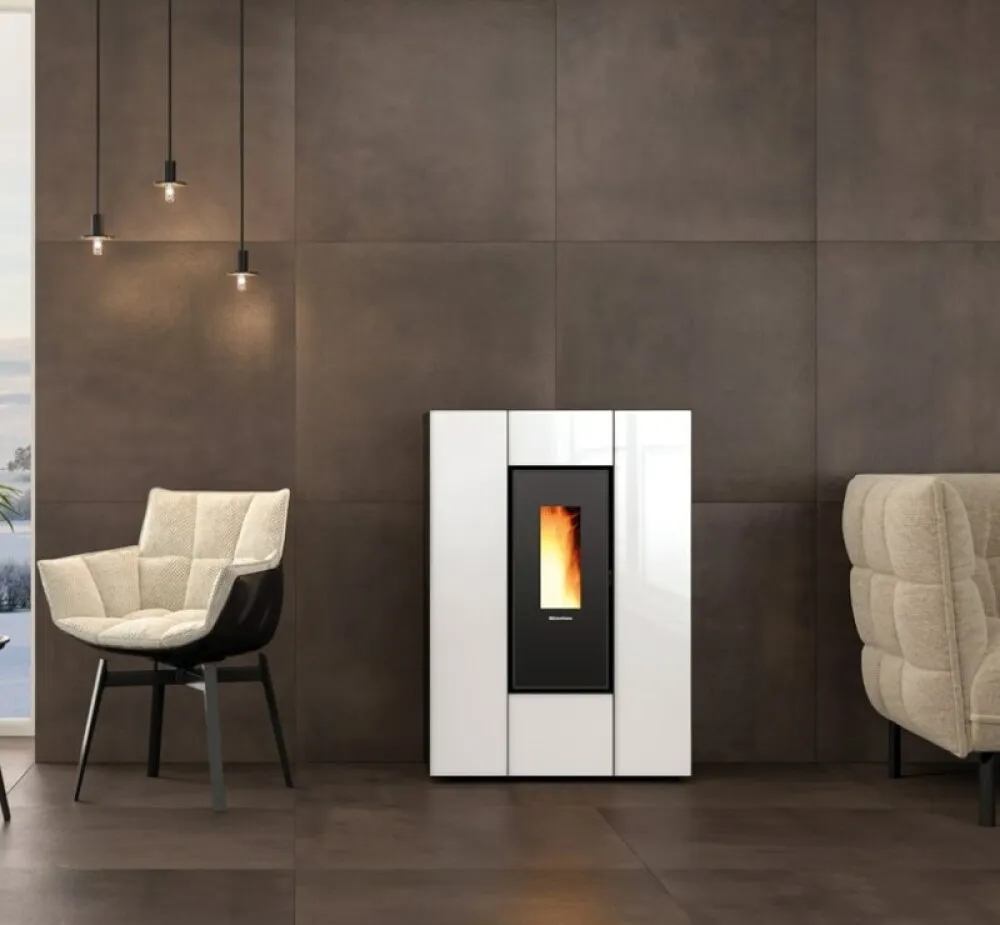
Choosing a pellet or wood-burning stove does not simply mean finding the model with the highest number of kW. A stove that is too underpowered may struggle to bring the room up to the desired temperature; an oversized one, on the other hand, may often run at minimum output, resulting in less efficient consumption and comfort that is not always ideal. So, to understand how many kW are needed to heat 100 sqm, you need to consider not only the surface area, but also ceiling height, building insulation, climate zone and room layout.

How many kW are needed to heat 100 sqm?
As a first indication, a 100 m² home may require approximately 8 to over 13 kW, but the figure can vary significantly depending on the characteristics of the building.
The reason is simple: 100 m² in a recently built, well-insulated apartment in a mild climate does not have the same heating requirements as a house from the 1960s, with poorly performing windows, high ceilings and particularly cold winters.
That is why simply asking "how many kW for 100 m²?" is a useful starting point, but it is not enough to choose the right pellet stove or wood-burning stove.

How to calculate the kW you need: start with cubic metres
For an initial estimate, it is more accurate to consider the volume to be heated, rather than just the floor area.
The basic formula is:
floor area × ceiling height = room volume
Let us take a 100 m² home with 2.70 m-high ceilings as an example:
100 × 2.70 = 270 m³
At this point, you can apply an indicative coefficient linked to the building's heat loss. As a general guide:
| Home characteristics | Indicative heat requirement | Power for 270 m³ |
|---|---|---|
| Good insulation | 20-30 W/m³ | 5.4-8.1 kW |
| Average insulation | 30-40 W/m³ | 8.1-10.8 kW |
| Poor insulation | 40-50 W/m³ | 10.8-13.5 kW |
This is, of course, a preliminary estimate. The final sizing of the heating system must take into account the actual heat loss of the building and the local climate conditions.
In any case, you'll be happy to know that our catalogue already includes some very handy filters: simply select the area to be heated and the desired power output. For example:
Wood-burning stoves for 100-110 m²

Pellet or wood-burning stove: does the required power change?
The calculation of the kW needed to heat a room does not change according to the fuel: what determines the heating requirement is mainly volume, insulation, heat loss and climate zone. A 10 kW pellet stove and a 10 kW wood-burning stove, if that figure refers to useful heat output, can therefore provide a comparable amount of heat. What changes is mainly efficiency and how the heat is delivered. Pellet offers more regular, easily adjustable combustion, while the performance of wood depends more heavily on the wood species, moisture content and the amount loaded. That is why, when comparing models, it is important to look at the useful heat output declared by the manufacturer, not just the type of fuel.
Read here: Wood-burning or Pellet Stove? Differences, Costs and How to Choose + 7 Best-Selling Models

Insulation and climate zone can completely change the result
Two homes with the same floor area can require very different power outputs. The level of thermal insulation is one of the most important factors to consider: external insulation, windows, glazing, roof and wall construction all directly affect how much heat is lost.
The climate zone also matters a great deal. Heating 100 m² in an area with mild winters is very different from heating the same floor area in the mountains or somewhere where temperatures remain below freezing for long periods.
The building's exposure, the number of walls facing outdoors and whether there are heated or unheated rooms above or below can also significantly affect the heating requirement. That is why choosing a stove based only on the square metres stated by the manufacturer can be rather imprecise.

Pellet or wood-burning stove: pay attention to rated power
When comparing different models, it is important to check exactly which power figure is shown in the technical specifications. For home heating, the most useful figure is the useful heat output, meaning the heat that is actually available to warm the room.
For a 100 m² home with average insulation, for example, around 9-11 kW can be a reasonable initial reference point, but it is by no means a universal rule.
And let's all say it together once more: automatically choosing a much more powerful stove "just to be safe" is not a good idea. An oversized appliance can reach the set temperature very quickly and then spend much of its time running at low output or, with some appliances, switching on and off more often than necessary.

Can one stove really heat 100 m²?
It mainly depends on the layout of the home. A stove installed in a large open-plan space can distribute heat fairly easily; in a home divided into many rooms, corridors and different floors, however, power alone does not guarantee that the heat will be distributed evenly.
In these situations, ducted stoves, which can channel hot air into other rooms, or hydro pellet stoves, designed to transfer part of their heat to the home's heating system water, can be interesting options.
So before buying, you should ask yourself not only "how many kW do I need?", but also where does the heat need to go?

Why a more powerful stove does not necessarily mean more comfort
It may seem natural to think that a few extra kW can only be a good thing. In reality, correct sizing is all about finding the right balance between power, consumption and comfort.
A properly sized stove can operate for longer periods under the conditions intended by the manufacturer, modulating its output without having to compensate for an appliance that is either too large or too small.
With pellet stoves, hourly consumption also changes depending on the power level being used. That is why comparing two appliances based only on maximum output makes little sense: efficiency, modulation capacity, heatable volume and the characteristics of the home should all be considered together.

Sealed or ducted: does it change the kW calculation?
The type of stove does not change the home's heating requirement, but it can make a big difference to how the heat is managed. For example, a sealed pellet stove draws the air required for combustion from outdoors and is particularly suitable for well-insulated buildings, while a ducted pellet stove can channel part of the hot air into other rooms. In the latter case, it is important to check not only the stove's total power, but also how that output is divided between the main room and the ducted rooms. So, when choosing the right model, the kW you need should always be considered alongside the layout of the space; by now, you probably know that one by heart.

FAQ: how many kW are needed to heat 100 smq?
How many kW are generally needed for a 100 m² home?
Approximately 8-13 kW may be needed, but the figure can be lower or higher depending on insulation, ceiling height, climate and heat loss.
Can a 10 kW stove heat 100 m²?
It may be suitable for many homes with average insulation, but floor area alone is not enough to determine this. Volume and building heat loss also need to be considered.
Is it better to choose a slightly more powerful stove?
Not necessarily. Excessive oversizing can cause the stove to operate frequently at minimum output and does not automatically guarantee lower consumption or greater comfort.
Should I use square metres or cubic metres to calculate the required power?
Cubic metres allow for a more accurate estimate because they also take ceiling height into account. Simply multiply the floor area by the internal height of the room.
How many kW are needed for a well-insulated 100 m² home?
In a well-insulated building, the heating requirement can be significantly lower than in an older property. Using an indicative value of 20-30 W/m³, a 100 m² home with a ceiling height of 2.70 m would require approximately 5.4-8.1 kW.
How many kW are needed for a poorly insulated 100 m² home?
With high heat loss, the requirement can rise to approximately 40-50 W/m³ or more. In the 270 m³ example, that would mean around 10.8-13.5 kW.
Can a pellet stove heat several rooms?
Yes, but it depends on the layout of the home and the type of stove. In homes divided into many separate rooms, a ducted model designed to distribute hot air to multiple spaces may be worth considering.
Can a hydro pellet stove heat 100 m² through radiators?
A hydro pellet stove can be connected to the hydraulic heating system and contribute to heating through radiators or other terminals. In this case, however, the power transferred to the water must be taken into account and the entire system needs to be sized correctly.
What is the difference between maximum output and useful heat output?
Useful heat output is the amount of heat actually available for heating. It is one of the main figures to consider when comparing pellet and wood-burning stoves.
How can I know exactly how many kW my home needs?
For accurate sizing, you need to calculate the building's heat loss, taking into account construction characteristics, heat-loss surfaces, windows, outdoor design temperatures and the desired indoor temperature.

Useful Links and Contacts
If you've made it this far, you're probably ready to move from theory to the actual choice. To make your search easier, we've gathered all the useful links below. And if you still have questions or would like more tailored free support, our Team is always available for a free consultation: contact us here.
You can also browse our Catalogue and narrow down the results in just a few clicks, combining the filters that best suit your needs: type, brand, class, heat output, dimensions, colour and price range.
- Pellet stoves
- Ducted pellet stoves
- Ventilated pellet stoves
- SLIM pellet stoves
- Airtight pellet stoves
- Caminetti Montegrappa pellet stoves
- Extraflame Nordica pellet stoves
- Eva Calòr pellet stoves
- Wood-burning stoves
- Natural-convection wood-burning stoves
- Ducted wood-burning stoves
- Ventilated wood-burning stoves
- Wood-burning cookers
- Nordica wood-burning stoves
- Caminetti Montegrappa wood-burning stoves
- Eva Calòr wood-burning stoves
And if you'd like to keep browsing through the latest news, brands and most interesting models on the market, or you're looking for more practical ideas to make your home more functional and comfortable, take a look at these articles too:
- How Much Electricity Does a Tumble Dryer Use? Complete Guide + 5 Models to Know
- Wood-burning or Pellet Stove? Differences, Costs and How to Choose + 7 Best-Selling Models
- What Temperature Should the Fridge Be Set To: 5 Tips for Storing Food Properly
Winter is just around the corner: make sure you're ready.
See you next time!
Your Vieffetrade Team